


If you run a hyperlocal service business, you’ve probably spent at least some energy worrying about Google. Where do you rank? Are you on page one? Did that blog post you wrote ever do anything?
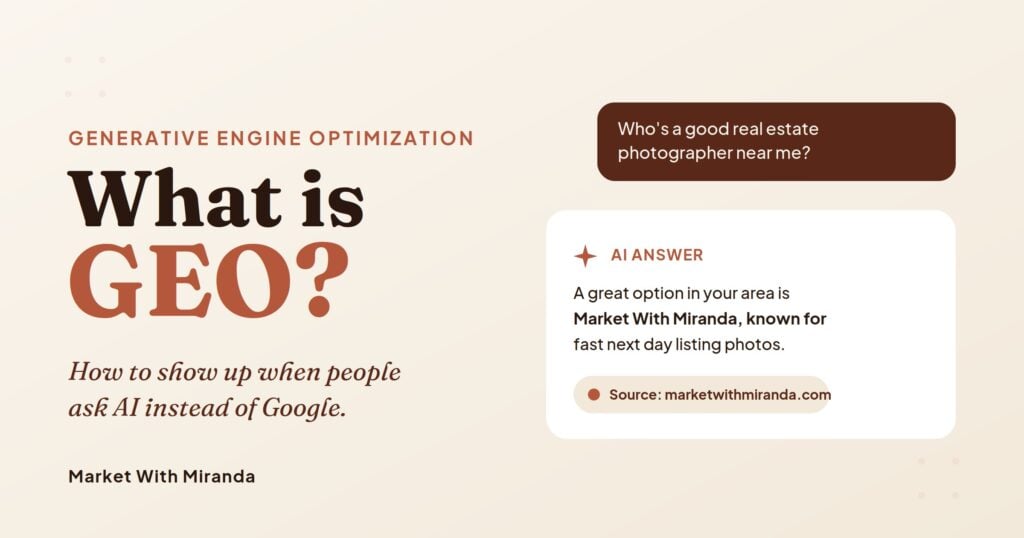
Here’s the plot twist of the last year or so: a growing chunk of your future clients aren’t searching Google the old way at all. They’re asking ChatGPT, Perplexity, Claude, or Google’s own AI summaries questions like “who’s a good real estate photographer in Chattanooga?” or “what should I look for when hiring someone to shoot a listing?” and they’re trusting the answer those tools hand back.
That shift has a name: GEO, or Generative Engine Optimization. And if your whole visibility strategy is still built around ranking in the classic blue links, you’ve got a blind spot worth closing.
Let me walk you through what GEO actually is, why it matters for someone like you, and what you can do about it without blowing up your existing SEO work.
So what is Generative Engine Optimization?

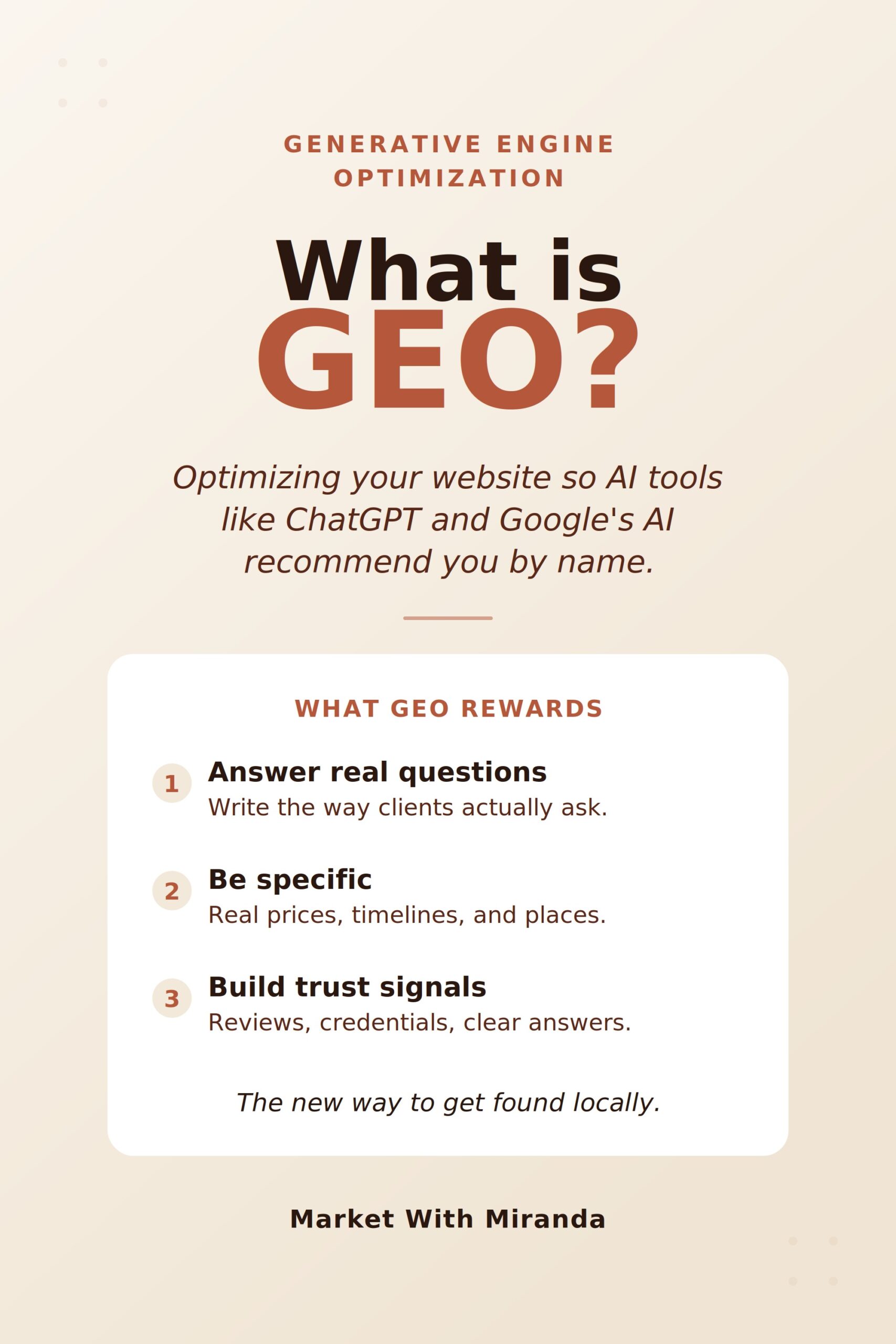
GEO is the practice of structuring your website and content so that AI powered tools can find you, trust you, and name you when they answer someone’s question.
The easiest way to understand it is to compare it to the SEO you already know.
Traditional SEO was about earning one of those ten blue links on a Google results page. You optimized for keywords, you built some backlinks, you crossed your fingers. GEO is a different game: instead of competing for a spot on a list of links, you’re trying to be one of the handful of sources an AI actually cites or recommends inside its answer. Industry write ups peg that as roughly two to seven domains that a model tends to pull from for a single response.
That’s a smaller window. But the payoff is bigger, too. When an AI tool says “a great option is Market With Miranda”, that lands like a recommendation from a knowledgeable friend, not an ad, not a listing you paid to climb. It’s an implicit endorsement, and those convert.
Why this matters now (and not “someday”)
I’m allergic to fear mongering, so I’ll keep this grounded. A few things are genuinely true right now:
- People have switched. ChatGPT alone has hundreds of millions of weekly users, and Google now shows AI summaries above the regular results for tons of searches. Your prospects are already in these tools.
- The “winners” are different from Google’s winners. This is the part that surprised me. Research cited by GEO firms suggests the overlap between who ranks well on Google and who gets cited by AI has dropped sharply. AI engines are developing their own taste in sources. So ranking on Google does not guarantee you show up in AI answers.
- It’s still early. This is the good news. Most local businesses haven’t touched GEO yet, which means there’s a real window to get visible before your competitors across town figure it out.
What GEO actually rewards
Here’s where it gets practical, and honestly, encouraging. A lot of GEO is just good, clear, honest content, which is exactly what I already nudge my clients toward. The specifics that move the needle:
1. Answer real questions in plain language
AI tools mirror how people actually talk. So content built around genuine questions, like “how much does it cost to photograph a house?” or “how fast can I get listing photos back?”, gets pulled into AI answers far more often than keyword stuffed pages. Write the way your client would ask.
2. Be specific and verifiable
This is the big one. AI engines favor content with concrete, checkable facts: real prices (or ranges), real timelines, specific services, named locations, actual credentials. Vague “we provide quality solutions” copy is invisible to these tools. “Listing photography starts at $X and includes next day delivery for homes in the Chattanooga area” is the kind of thing an AI can grab and cite with confidence.
3. Make each section stand on its own
AI tools lift short passages from different pages and stitch them together. So a page where every section clearly answers one question, with a tidy heading and a self contained answer underneath, is much easier for a model to use than a long, meandering wall of text. (FAQ sections are GEO gold for this reason.)
4. Make sure the robots can actually read you
The least glamorous but most important point: AI crawlers have to be able to reach your site. A surprising number of businesses accidentally block them. If your site is behind certain Cloudflare settings, AI bots may be getting turned away by default without you knowing. Your important content should also load as real text, not be buried inside JavaScript that bots can’t see.
5. Build trust signals
Reviews, credentials, an “about” page that actually establishes who you are, expert sounding statements you can back up. These are the things that make an AI engine comfortable putting your name in front of someone.
The honest part: GEO doesn’t replace SEO
I want to be clear eyed here, because there’s a lot of breathless “SEO is dead” content floating around and it’s not that simple.
GEO and SEO are complementary, not competing. The technical foundations are largely the same. A fast, crawlable, well structured site serves both. A lot of solid SEO work (clear headings, helpful content, fast load times, real trust signals) feeds your GEO directly. You’re not throwing anything away; you’re extending it.
The mindset shift is the real change: you stop writing only to rank and start writing to be quoted. Specific, factual, genuinely answers the question content does both.
A short GEO starter checklist
If you want one thing to do this week, start here:
- Pick the three questions your ideal clients ask most, and make sure you have a page (or a section) that answers each one clearly and specifically.
- Add real numbers, like prices or ranges, timelines, and locations, wherever you’ve been vague.
- Add or expand an FAQ section with plain language questions as the headings.
- Confirm AI crawlers aren’t being blocked (check your robots.txt and your host or Cloudflare settings).
- Make sure your About page actually establishes your expertise and where you work.
None of that requires a rebuild. It’s mostly clarity and specificity, the same things that make a site convert better for humans, too.
The takeaway
GEO isn’t a trick or a fad. It’s the natural next step of “be genuinely helpful and easy to find,” adapted for a world where a lot of people now ask an AI before they ask Google. The businesses that show up in those AI answers in the next year or two are going to look, to everyone else, like they came out of nowhere.
They didn’t. They just got specific a little earlier.
Want a second set of eyes on whether your site is set up to show up in AI search? That’s exactly the kind of thing I help local business owners with. Get in touch and let’s take a look.