Facebook Ads vs. Pinterest Ads: Which Is Right for Your Business?
This guide was first published in 2021 and has been fully updated for 2026 with current user numbers, ad formats, targeting tools, and cost benchmarks.
When it comes to running digital ad campaigns, marketers today have a daunting array of platforms to choose from. Among them, Facebook and Pinterest stand out for very different reasons, and each offers powerful tools to connect with potential customers. But how do you decide which platform is more effective for your business?
Below, I break down the differences between Facebook Ads and Pinterest Ads, covering everything from audience demographics to ad formats, targeting options, and cost. By the end, you’ll have a clear picture of which platform aligns best with your marketing goals, and when it makes sense to run both.
Facebook Ads vs. Pinterest Ads at a Glance
| Facebook Ads | Pinterest Ads | |
|---|---|---|
| Monthly active users | Over 3 billion | 640 million |
| Audience skew | Broad, all ages, roughly even gender split | About 70% women, strong with Millennials and Gen Z |
| User mindset | Socializing, scrolling, catching up | Planning, searching, deciding what to buy |
| Targeting strength | Deep behavioral and lookalike data | Keyword and interest intent |
| Typical CPC | Around $1.50 to $1.75 | Around $0.50 to $1.50 |
| Typical CPM | Around $14 | Around $3 to $9 |
| Best for | Reach, lead gen, retargeting, community | Visual products, e-commerce, high-intent discovery |
Understanding the Core Users of Facebook and Pinterest
Facebook: The Global Community
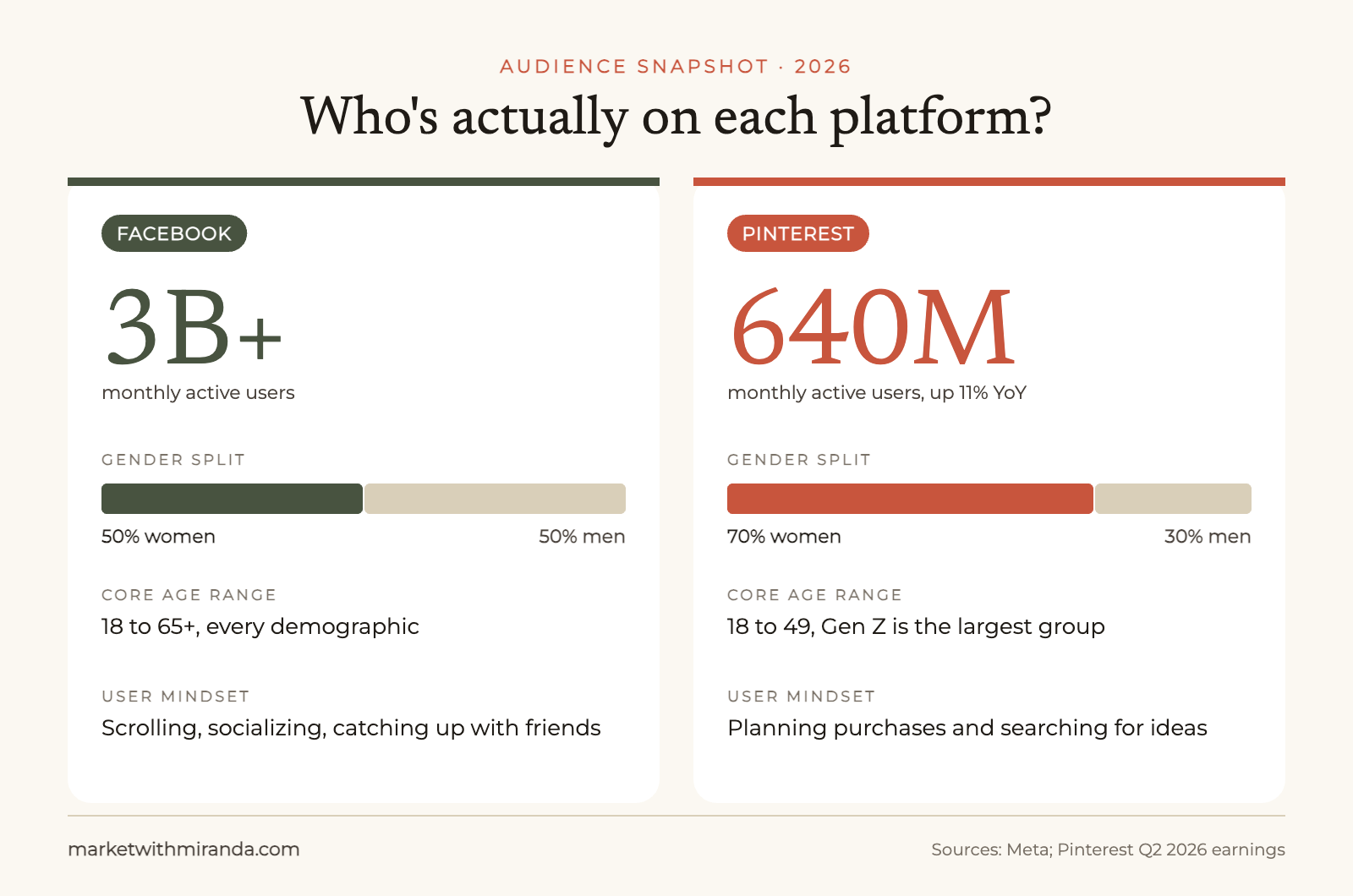
Facebook is an undeniable titan with more than 3 billion monthly active users. Its audience is broad and spans virtually every demographic:
- Age groups: Facebook’s fastest-growing segments are now older, but it still reaches users from 18 to 65+.
- Gender balance: Facebook maintains a relatively even split between male and female users.
- Geographies: With users worldwide, it’s especially strong in markets like the US, India, and Indonesia.
The takeaway? Facebook provides access to a large, general audience, making it an excellent choice for mainstream consumer brands or businesses seeking maximum reach.
Pinterest: A Hub of Inspiration
Pinterest, on the other hand, caters to a smaller but deeply engaged audience of 640 million monthly active users, a record high as of mid-2026 and up 11% year over year:
- Age groups: Gen Z is now Pinterest’s largest and fastest-growing audience, with Millennials close behind. Most users fall between 18 and 49.
- Gender skew: Roughly 70% of Pinterest users are women. Men are increasingly active on the platform, but it continues to attract a predominantly female audience.
- User intent: People come to Pinterest to plan purchases and find inspiration. Categories like fashion, home décor, DIY, beauty, weddings, and food do particularly well here.
If your brand thrives on visual appeal and planned purchases, Pinterest offers an audience that is often further into the buying funnel than a casual Facebook scroller.
Comparing Ad Formats
Facebook Ads
Facebook’s ads are versatile and user-focused. Popular formats include:
- Image or video ads: Great for storytelling or showcasing a product visually.
- Carousel ads: Perfect for displaying multiple products or offering step-by-step guides.
- Lead generation ads: Capture emails directly within the app for easy conversion.
- Reels ads: Short vertical video placed between organic Reels, now one of Meta’s highest-reach placements.
- Event promotion: Ideal for driving RSVPs or foot traffic to in-person events.
With Facebook’s flexibility in ad creative, businesses from direct-to-consumer (DTC) brands to service providers can experiment with presentation and messaging.
Pinterest Ads
Pinterest offers fewer formats, but its options cater well to the platform’s purpose of discovery. Current ad options include:
- Standard ads (Promoted Pins): Blend seamlessly into a user’s feed and search results, giving the ad a natural feel.
- Video ads: Auto-playing vertical video, including max-width video that spans the full feed.
- Carousel ads: Tell a broader story or showcase multiple facets of a single product.
- Shopping ads and collections: Automatically promote products from your catalog, with collections pairing a hero image and a product grid. Perfect for e-commerce brands.
- Showcase and quiz ads: Interactive formats that let users swipe through cards or answer a quick quiz to get personalized results.
Note that Idea Pins, which used to be part of this list, were retired in 2024. Pinterest ads are inherently visual, and brands behind home goods, crafts, recipes, and fashion continue to see great success thanks to the platform’s scroll-stopping aesthetic.
Targeting Options
Facebook’s Advanced Algorithm
Facebook’s targeting is data-driven and sophisticated, using its massive user base as its advantage. Advertisers can target users based on:
- Demographics: Age, gender, location, and life events.
- Interests and behaviors: Hobbies, media consumption, and purchase behavior.
- Custom audiences: Retarget your website visitors or sync your own contact lists for highly personalized ad delivery.
- Lookalike and Advantage+ audiences: Scale campaigns by letting Meta’s AI find users who resemble your existing customers.
Meta has trimmed some of its most granular detailed-targeting options in recent years and leans harder on automated Advantage+ targeting, but if you need pinpoint accuracy and strong retargeting, Facebook’s breadth of user data is still tough to beat.
Pinterest’s Intent-Based Targeting
While less comprehensive than Facebook’s tools, Pinterest’s targeting focuses heavily on user intent. Options include:
- Demographics and interests: Similar to Facebook, but built around what people search for and save rather than what they like.
- Keyword targeting: Reach users actively searching for the solutions your business offers, much like search advertising.
- Actalike audiences: Pinterest’s version of lookalikes, letting you scale campaigns based on current customer profiles.
- Performance+: Pinterest’s automated campaign type that handles targeting and bidding for you, useful if you want to test the platform without a lot of manual setup.
Pinterest shines when users are intentionally searching or open to discovering new ideas, which is the key differentiator from Facebook’s interruption-style targeting.
Cost-Effectiveness and ROI
Facebook’s Competitive Environment
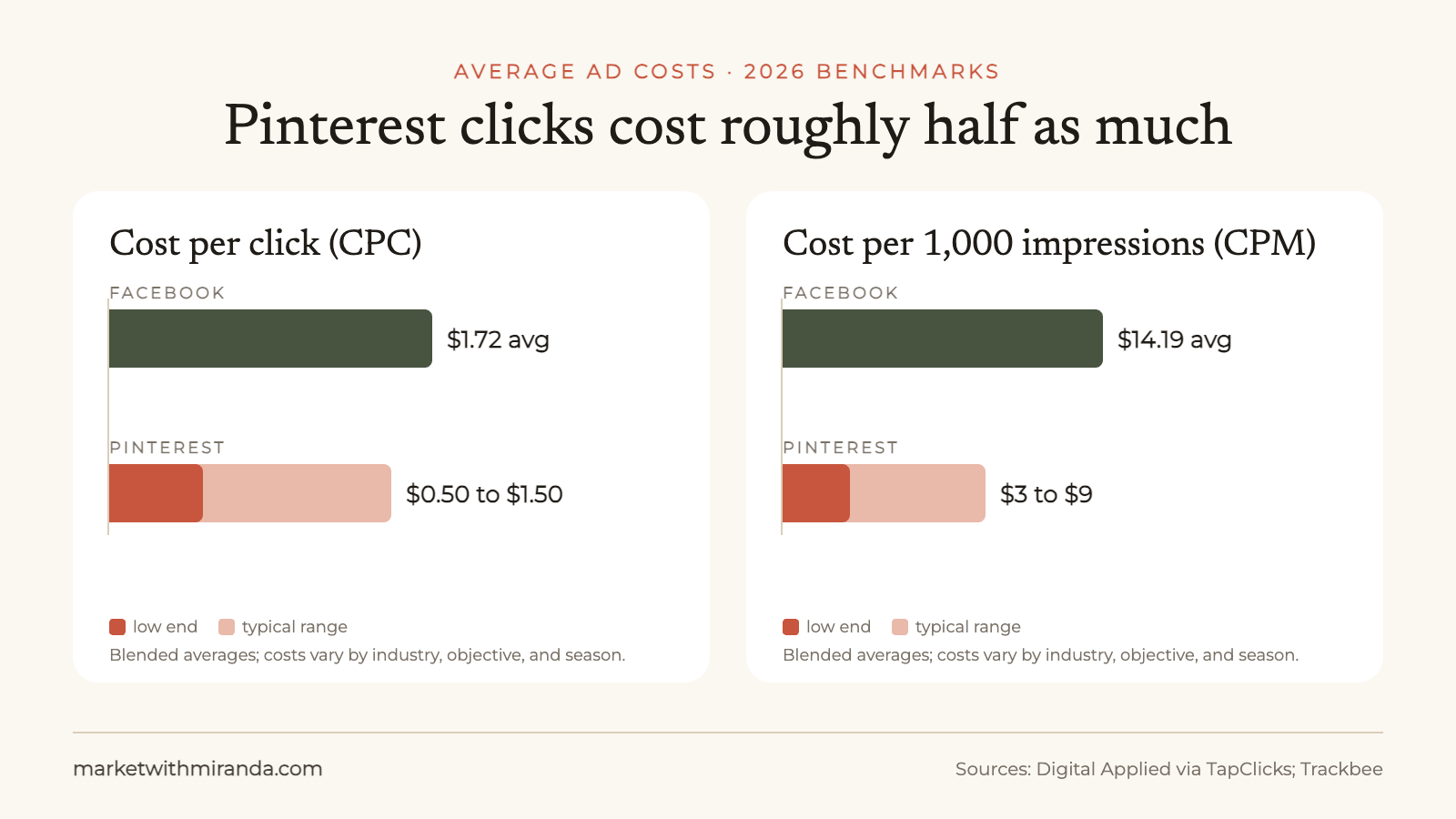
The broad targeting capacity on Facebook comes with competition, and a higher price tag. Costs vary a lot by industry and objective, but 2026 benchmarks put the blended averages at roughly:
- CPC: around $1.50 to $1.75, up about 11% from last year
- CPM: around $14
While costs are higher, Facebook’s precise targeting and large audience size often lead to a strong return on investment for businesses focused on leads and conversions.
Pinterest’s Affordable Entry
Pinterest ads generally cost less than Facebook ads, especially for businesses targeting niche markets:
- CPC: around $0.50 to $1.50
- CPM: around $3 to $9
Though Pinterest doesn’t match Facebook’s analytics depth, its users often arrive motivated to purchase, which leads to strong ROI in visually driven industries. Pinterest also reports that pins keep driving traffic for months, so a promoted pin can continue working long after the campaign ends.
Who Wins Where?
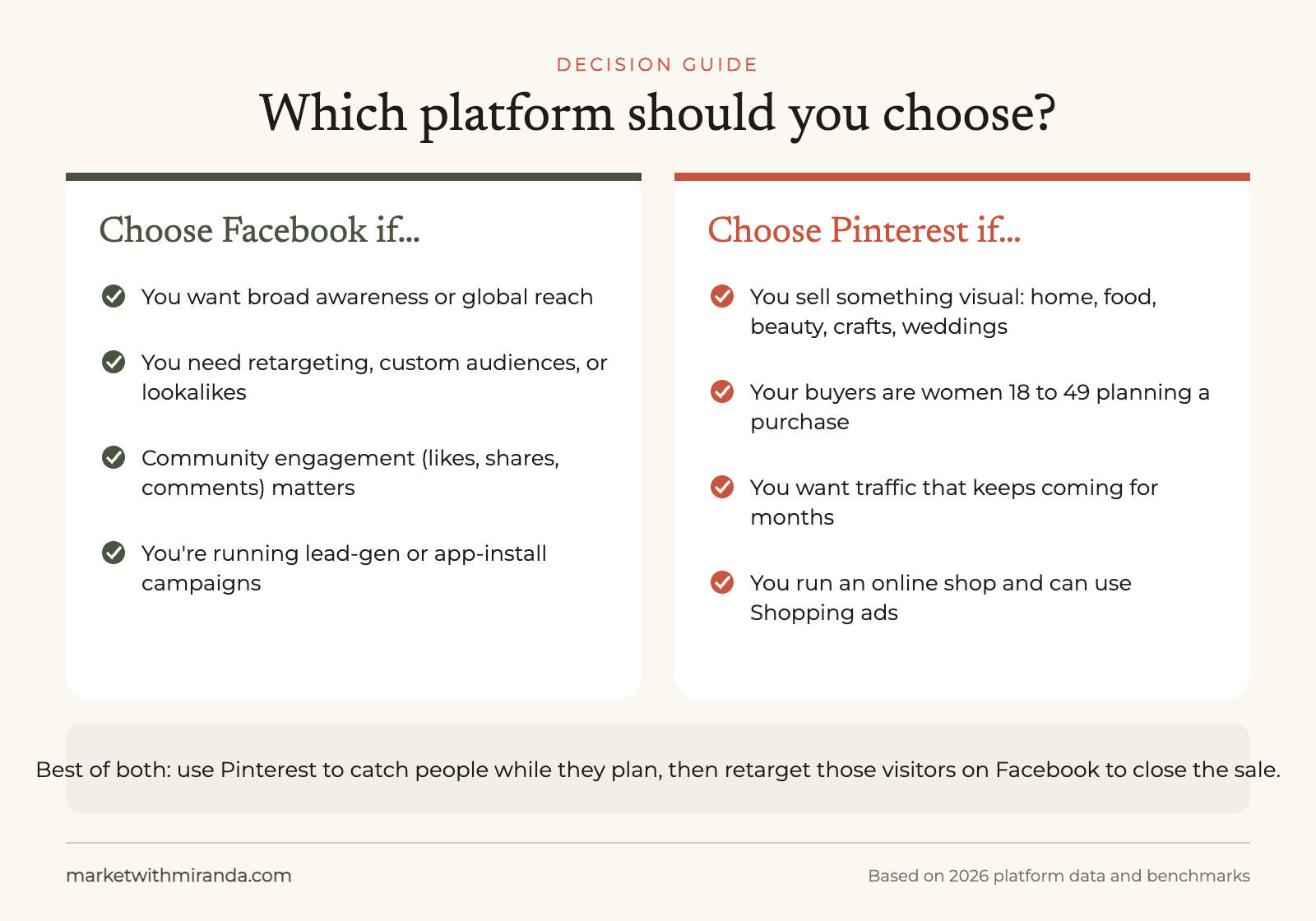
Deciding between Facebook Ads and Pinterest Ads often comes down to your business type and goals. Here’s a breakdown of what each platform is best for.
Facebook Wins If
- Your objective is broad audience awareness or global reach.
- You need advanced targeting and retargeting (custom audiences, lookalikes, website visitors).
- Your campaigns focus on community engagement through likes, shares, and comments.
- You’re running a direct conversion campaign for lead generation or app downloads.
Pinterest Wins If
- You’re in a visual industry (home, cooking, beauty, crafts, weddings, fashion).
- Your target audience includes women aged 18 to 49 who are planning purchases.
- Your marketing relies on visuals to inspire discovery.
- You sell products online and want to take advantage of Shopping ads and collections.
Tips for Choosing the Right Platform
- Understand your audience: Research which platform aligns with your demographic. Are they browsing Facebook casually, or actively searching Pinterest for inspiration?
- Define your goals: For lead generation and engagement, Facebook wins. For product discovery and shoppable moments, Pinterest excels.
- Experiment: Test small-budget campaigns on both platforms and compare CPC, click-through rate (CTR), and ROI before committing.
- Leverage both: If your budget allows, use Pinterest to capture high-intent discovery traffic, then retarget those visitors on Facebook to close the sale.
What’s Changing Heading Into 2027
Both platforms are moving in the same direction: less manual targeting, more automation. Meta keeps pushing advertisers toward Advantage+ campaigns, where its AI picks the audience, placement, and even creative variations for you. Pinterest’s answer is Performance+, which does the same for targeting and bidding, and it has been rolling out AI-powered features like visual search shopping and automatic product tagging that make it easier to sell directly from a pin.
For small businesses, that shift is good news. You need less expertise to get a campaign running on either platform than you did a few years ago, and the gap is narrowing between “Facebook is for targeting” and “Pinterest is for discovery.” What has not changed is the audience mindset: Pinterest users are still planning, and Facebook users are still scrolling. Build your creative for that mindset and let the automation handle the rest.
Two things to watch in 2027: Gen Z continues to grow its share on Pinterest, which makes the platform more relevant for brands that assumed it was only for millennial moms, and Meta’s ad costs keep climbing roughly 10% a year, so the cost gap between the two platforms is likely to widen rather than shrink.
Facebook Ads vs. Pinterest Ads FAQs
Are Pinterest ads cheaper than Facebook ads?
Usually, yes. Pinterest CPCs and CPMs tend to run well below Facebook’s, especially in niche visual categories. The gap narrows in competitive e-commerce categories during Q4.
Can I run ads on both Facebook and Pinterest?
Absolutely, and for product-based businesses it’s often the best approach. Pinterest catches people early while they’re planning, and Facebook retargeting brings them back when they’re ready to buy.
Which platform is better for a small business with a tiny budget?
If you sell something visual, start with Pinterest. The lower costs and longer shelf life of promoted pins stretch a small budget further. If you sell a service or need leads fast, Facebook’s lead forms are hard to beat.
Final Thoughts
Both Facebook Ads and Pinterest Ads offer real opportunities to promote your brand. Facebook delivers unmatched reach and precise targeting, while Pinterest excels at putting visually driven inspiration in front of eager buyers. The right choice depends on your customer demographics, marketing goals, and creative strategy. Take the time to evaluate your priorities, and you’ll unlock the full potential of your ad campaigns.